
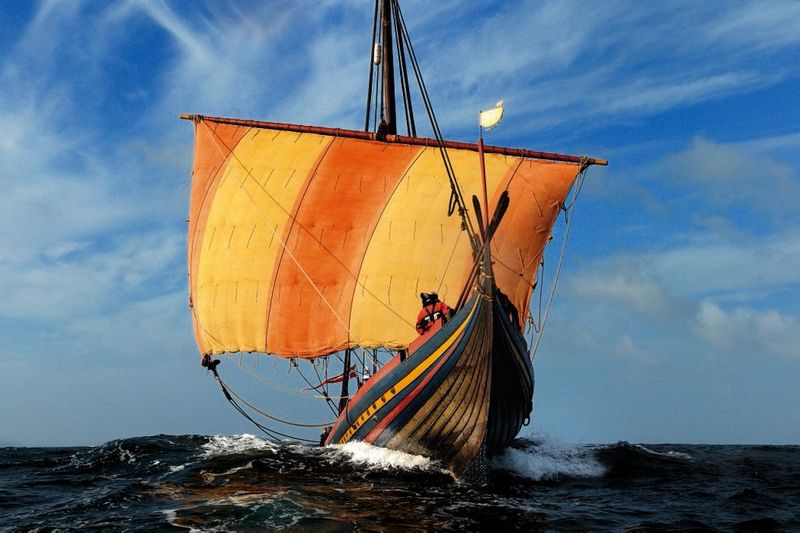
The Skuldelev ships are five shipwrecks from the late Viking Age found in Roskilde Fjord near the village of Skuldelev. The ships were built in the period 1030-1050 and were in use for 20-30 years before they were sunk as old and worn-out ships and used to block the Peberrenden, which was the most direct shipping lane to Roskilde.
The reason for the blocking is thought to be as a defense against Haraldr Harðráði (Harald Hårderåde)’s repeated attacks, in his power struggle with Svein Estridsøn for supremacy over Denmark-Norway.
In 1957-1959, the ships were examined by divers, as one of the very first marine archaeological investigations in Denmark. After the initial underwater investigations, the area of the find was framed and pumped free of water. The ships were then excavated and salvaged in 1962, with great media attention.
During the excavation, it was difficult to determine how many ships had been found. The first bid was for six. But after all the ship parts had been exposed, it became clear that Skuldelev 2 and 4 were the remains of the same ship. The five ships were subsequently numbered Skuldelev 1, 2, 3, 5 and 6.
The ships Skuldelev 1 and 6 were built in Western Norway. The first as a 16 m long and 4.8 m wide ocean-going cargo ship with a carrying capacity of more than 20 tons. The second as a 11.2 m long and 2.2 m wide smaller ship, used for fishing, sea hunting or transporting people and goods. Both ships are mainly built of pine.
Skuldelev 2 is a full 30 m long and only 3.7 m wide. The long and narrow ship – a so-called longship – is built for the rapid transport of a large crew of between 60 and 70 people. The longships could be propelled by both oars and sails and were used for warfare in the Viking Age and the early Middle Ages. Skuldelev 2 is mainly built of oak, and the ship’s construction site has been determined to be the area around Dublin in Ireland (which was then Danish).
All the ships have been reconstructed using Viking Age construction methods, materials and tools at the Viking Ship Museum in Roskilde, where the original ships are also on display.
Skuldelev 2 was launched on 4 September 2004 and christened “Havhingsten fra Glendalough” (“The Sea Stallion from Glendalough”) by Queen Margrethe II.
After some trial sailings in 2006, Havhingsten set off in July 2007 on a six-week voyage – with a crew of 60 people, led by skipper Carsten Hvid – north of Scotland to Dublin, where the original ship was built in 1042. The wood for this ship may have come from the Wicklow Mountains south of Dublin, where the Glendalough valley is located – hence the ship’s name. In the summer of 2008, the Sea Stallion sailed back to Denmark, south of England, and has since been based at the Viking Ship Museum’s harbor.
The ship is sailed and maintained by volunteers.